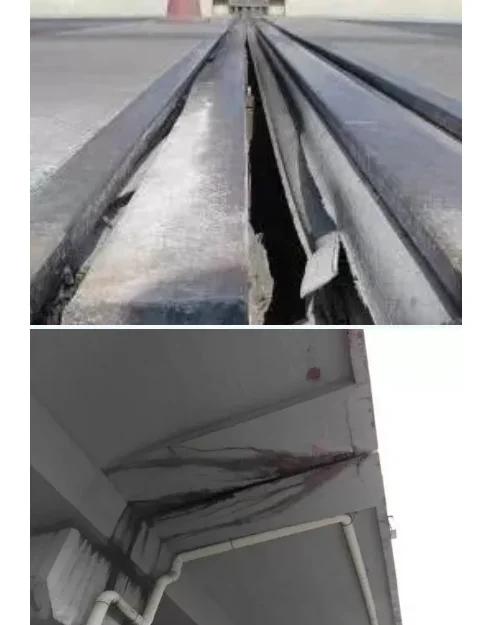
Technology Composition
To understand how AI and drones are used for bridge inspection, one must first grasp the technological foundation behind it.
Modern AI-powered drone bridge inspection systems are far more than simple aerial photography — they are integrated, intelligent solutions combining advanced hardware and software.
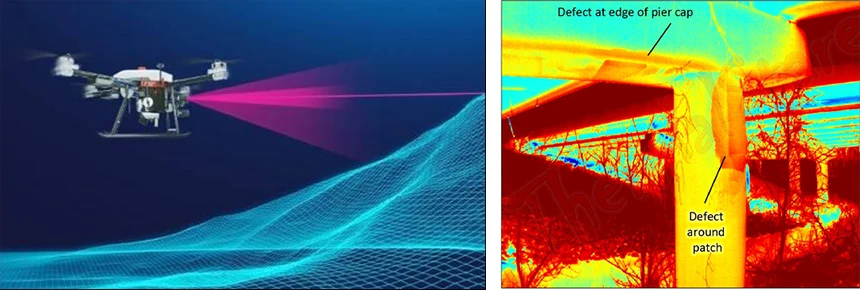
At the hardware level, drones are typically equipped with high-resolution optical cameras, infrared thermal imagers, and LiDAR sensors. These instruments not only capture surface-level damage but can also detect internal stress-related anomalies through thermal imaging.
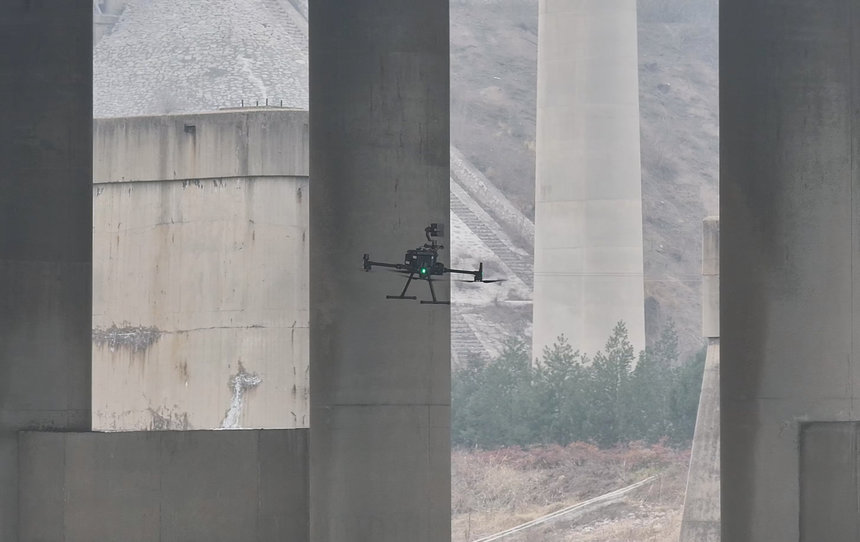
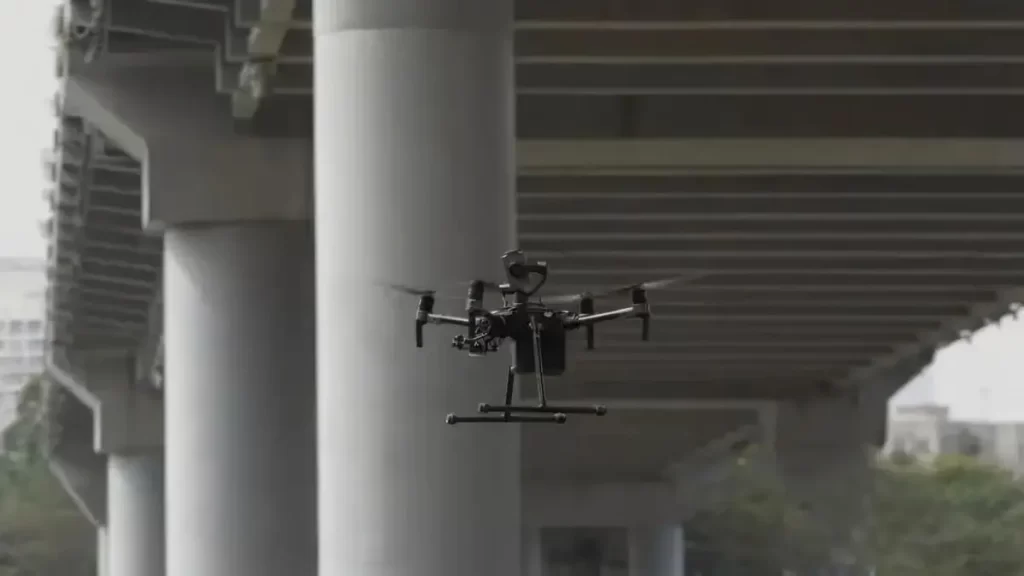
For areas beneath bridges where GNSS signals are blocked, drones rely on binocular vision combined with inertial navigation (INS) to maintain stable flight and precise imaging even without satellite positioning.
At the software level, the core technologies are flight path planning and AI-driven defect recognition.
Using centimeter-level 3D bridge models, drones automatically plan flight routes that fully cover the entire bridge — essentially performing a “CT scan” of its critical components.
The vast number of high-definition images collected are transmitted to the cloud or control center, where AI models take over the analysis.
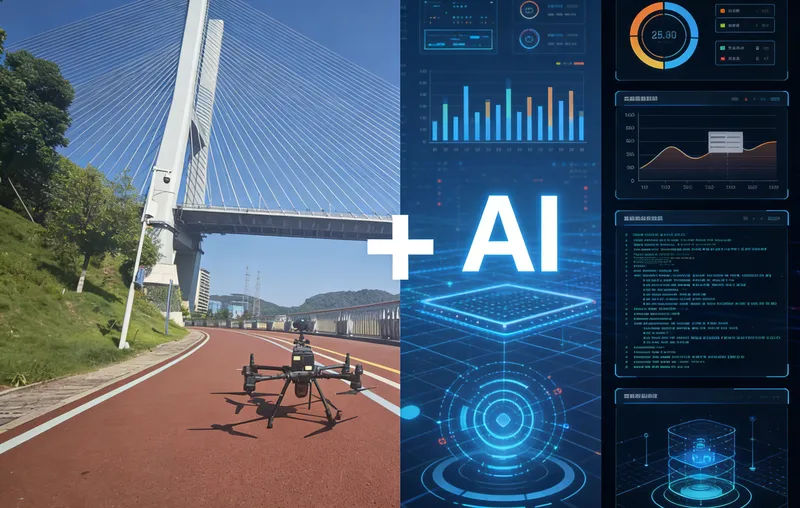
How AI Detects Bridge Defects
While drones solve the problem of “how to capture”, AI answers “how to interpret”.
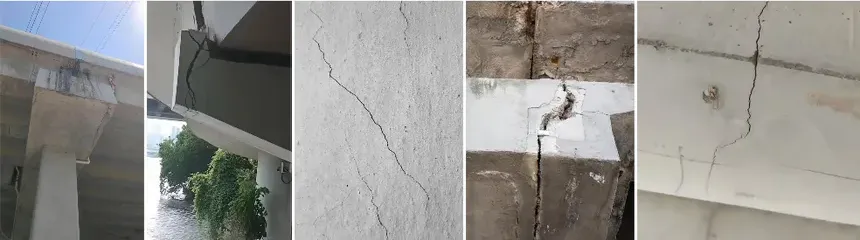
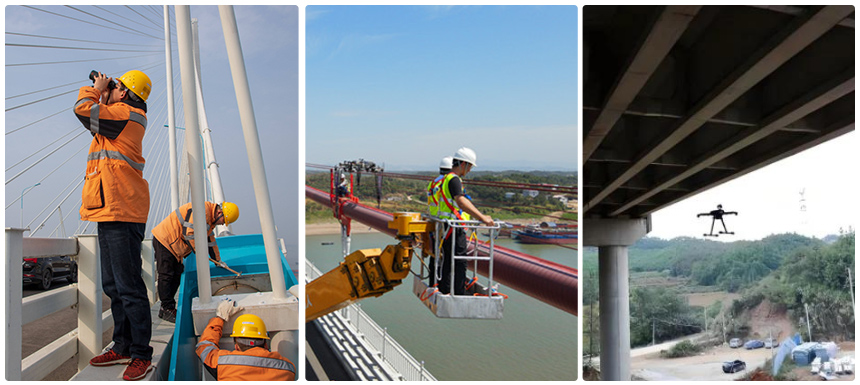
Traditionally, engineers had to manually sift through thousands of photos to locate cracks or corrosion — a time-consuming and error-prone task limited by human eyesight and fatigue. Studies show that manual crack detection accuracy drops below 0.5 mm resolution, and prolonged screen time often leads to oversight.
The introduction of deep learning has completely changed this process.
AI defect detection operates on two levels:
- Recognition — identifying the defect and classifying its type.
- Quantification — measuring its dimensions and severity.
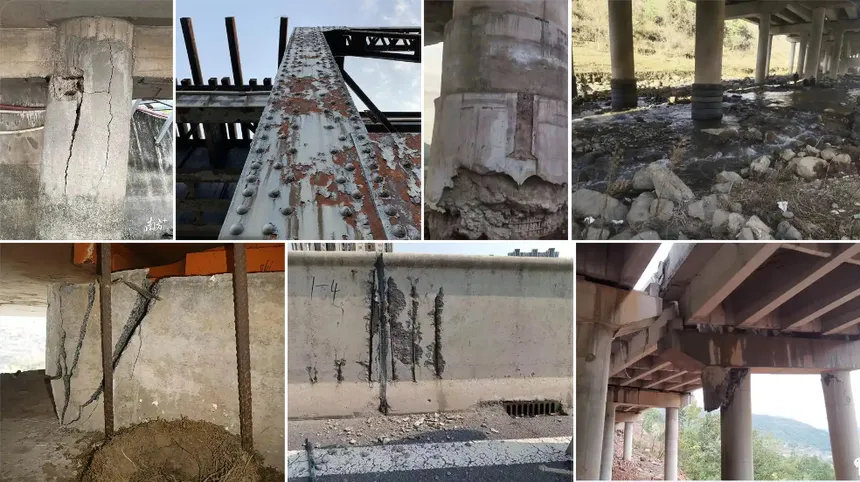
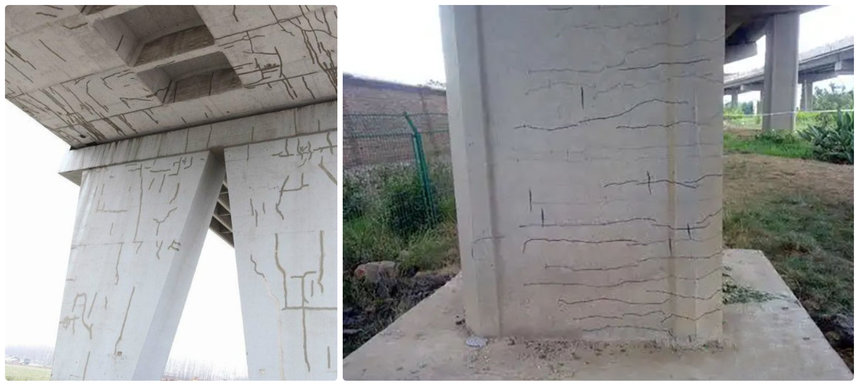
During recognition, advanced AI models (such as YOLOv8) use anchor-free object detection architectures to analyze images, automatically extracting textural and morphological features of cracks, spalling, and corrosion from complex backgrounds. The model then outlines the defect, labeling it with category and confidence level.
During quantification, the system uses the drone’s flight attitude data to convert pixel dimensions into real-world measurements.
With semantic or instance segmentation algorithms, AI performs pixel-level classification, accurately outlining crack paths, widths, and spalling boundaries (Example Riebo’s Drone Bridge Inspection Solution combines AI analytics with drone-based data collection to detect bridge defects precisely) .
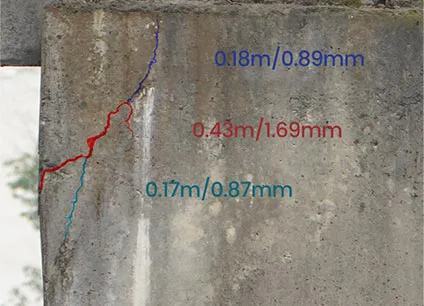
By combining distance data and segmentation results, AI can calculate crack length, width, and spalling area, providing a quantified assessment of defect severity.
For example, in the Hangzhou Bay Bridge pilot project, AI achieved a 0.15 mm image detection precision; at Liujiaxia Bridge in Gansu, it consistently detected cracks as fine as 0.2 mm — far beyond human capability.
Research shows that AI-driven defect detection models now achieve accuracy rates between 90% and 95%, greatly improving reliability and efficiency.
Application Scenarios: Comprehensive, Multi-Dimensional Inspection
The combination of AI and drones enables comprehensive inspection across all bridge components — from towering main cables to underwater foundations.
- For tall structures such as suspension bridge towers and main cables, drones can perform close-range orbital flights, replacing hazardous manual climbing operations.
- For confined spaces like the underside of decks or box girders, small drones maneuver easily into narrow areas, eliminating blind spots unreachable by humans.
- The latest innovation involves underwater inspection.
Traditionally, divers performed these inspections manually — a slow, dangerous, and imprecise process.
Today, engineers deploy a team of ROVs (remotely operated vehicles) and USVs (unmanned surface vessels).
ROVs capture high-resolution images underwater, while surface drones equipped with sonar systems perform CT-like scans of bridge piers, mapping precise 3D profiles of submerged structures, and even detecting scour or void risks beneath riverbeds.
Proven Benefits: Safety, Efficiency, and Cost-Effectiveness
Case studies across China have shown that AI-driven drone inspection systems deliver transformative benefits:
- Dramatically improved safety:
Automation has reduced high-altitude and over-water manual inspections by over 90%, effectively eliminating the need for risky “spider-man” operations. - Significantly higher efficiency:
Tasks that once required lane closures and several days can now be completed in 2–7 hours, cutting inspection time by two-thirds or more. - Lower lifecycle costs:
While initial equipment costs are higher, total lifecycle expenses are 20–40% lower than traditional bridge inspection vehicle methods.
Moreover, fewer lane closures reduce traffic congestion and social travel costs. - More scientific decision-making:
Inspection results are no longer fragmented paper reports but interactive 3D digital models.
Managers can view a bridge’s condition from any angle, identify defects instantly, and store georeferenced defect data for traceable, data-driven maintenance planning.
This transforms bridge management from reactive maintenance to proactive, predictive monitoring.
Future Outlook
As the low-altitude economy expands and AI continues to advance, drone-based intelligent inspection is moving from pilot programs to global deployment.
Whether applied to highway viaducts, cable-stayed bridges, or cross-sea mega-structures, the “Drone + AI” approach is rapidly becoming the standard practice for smart bridge maintenance.
In the near future, with the integration of automated drone docking stations, truly unattended, 24/7 autonomous inspections will become reality.
This technology not only ensures structural safety but also paints a clear blueprint for the smart, efficient, and data-driven management of transportation infrastructure.