(Trusted by 300+ municipal and transportation enterprises; ISO 9001 Quality Management System certified; compliant with international bridge maintenance standards including AASHTO and Eurocode)
The core demands of the bridge inspection industry focus on efficiency improvement, cost control, and regulatory compliance. Riebo Technology has been deeply engaged in the intelligent drone inspection field for years. Centered on empowering bridge maintenance with technology, the company has developed the Drone Bridge Inspection Solution (Riejian System) — an all-in-one solution integrating drones, high-definition cameras, AI software, and an inspection management platform. Combining low-altitude flight technology, high-resolution imaging, and AI intelligent recognition algorithms, it covers core needs such as full-component bridge inspection, precise defect identification, and closed-loop data management. The solution addresses the limitations of traditional manual inspection, providing efficient, safe, and compliant bridge inspection services for municipal and transportation enterprises, and helping highway bridge maintenance enter the era of digital intelligence. Below is a detailed breakdown of the solution’s core value.
Why Choose Riebo Technology’s Drone Bridge Inspection Solution?
When municipal and transportation enterprises select a bridge inspection solution, the core pursuit is high efficiency with low cost, precision and reliability, compliance with full traceability, and guaranteed service. Riebo Technology’s Drone Bridge Inspection Solution precisely matches these demands, with four core advantages that address key decision-making challenges — proven by data and field results:
✅ All-in-One Integrated Adaptation: The complete solution includes drones, high-definition cameras, AI intelligent analysis software, and an inspection management platform — no need for additional third-party equipment. Deployment time is reduced by 30%, integration costs are lowered by 20%, and it can be directly integrated with existing enterprise maintenance management systems, enabling seamless handoff across the full workflow of “capture → identify → analyze → archive” without switching between multiple systems.
✅ AI-Powered Precise Recognition: Equipped with advanced AI recognition algorithms, the system automatically identifies common bridge defects such as cracks, corrosion, loose bolts, and missing components, with a recognition accuracy of >=92% — significantly exceeding the industry average of 85%. It effectively reduces manual miss rates by 80%, while generating standardized defect reports to avoid manual recording errors, providing precise data support for maintenance decisions.
✅ Efficient, Safe, and Cost-Reducing: Drones can cover inspection blind spots that are difficult for humans to reach, such as bridge towers, main cables, and underwater components, achieving dual coverage of “aerial scanning + internal probing”. Inspection time per bridge is reduced by 60% — a task that previously required 2-4 hours of manual inspection can now be completed in just 20 minutes. Daily deployment can be reduced by 3 inspectors, cutting labor costs by 60%, while completely eliminating the safety risks of high-altitude and overwater operations through a “human-machine separation” safe inspection model.
✅ Compliance and Traceability: The solution fully complies with international bridge maintenance standards (including AASHTO and Eurocode requirements). Inspection data is stored in real time and fully traceable, with automated generation of compliance acceptance reports and support for data export and archiving — helping enterprises smoothly pass industry acceptance. It also builds a dynamic early warning system, driving the maintenance model from “reactive repair” to “predictive maintenance.”
4 Core Highlights: Solving the Pain Points of the Bridge Inspection Industry
Highlight 1: AI Intelligent Analysis Software -> Core Features: Powered by weakly supervised learning algorithms that autonomously learn the characteristics of different bridge defects, supporting automatic identification and grading of over 10 common defect types including cracks and corrosion. Adaptable to multiple bridge types such as highway bridges, railway bridges, and suspension bridges. Operates stably in temperatures ranging from -22 degF to 122 degF (-30 degC to 50 degC) and under wind, rain, and sandy conditions. -> Value Validation: Compared with traditional manual identification, efficiency improves 7-fold and recognition accuracy increases by 13%, eliminating subjective judgment errors and solving the “missed inspections and misjudgments” problem of traditional inspection. -> Field Case: A municipal department used this software to inspect 20 highway bridges under its jurisdiction. Defect identification that originally required 10 inspectors over 5 days was completed by just 2 technicians in 1 day, precisely identifying 32 fine cracks and promptly avoiding safety hazards, earning recognition from industry authorities.
Highlight 2: High-Resolution Aerial Capture System -> Core Features: Equipped with the SF10P medium-format super-telephoto inspection camera (103 megapixels, 11276 x 9200 resolution), enabling ultra-fine imaging of concealed bridge components with image resolution superior to 0.1mm. Supports real-time image transmission, compensating for the limited viewing angles of manual inspection. Combined with multi-constellation satellite navigation (GPS / BeiDou / Galileo), it delivers precise positioning even in signal-denied areas. -> Value Validation: Compared with standard drone inspection, imaging detail clarity improves by 50%, and concealed component inspection coverage rises from 30% to 95%, addressing the “blind spots and imprecise capture” limitations of traditional inspection. -> Field Case: The Linxia Highway Administration in Gansu, China, deployed this system for a specialized inspection of the Liujiaxia Bridge, focusing on steel structures, main cable clamps, and concealed bolt hazards. The inspection achieved full coverage with no blind spots, significantly improving suspension bridge inspection quality and advancing refined bridge maintenance.
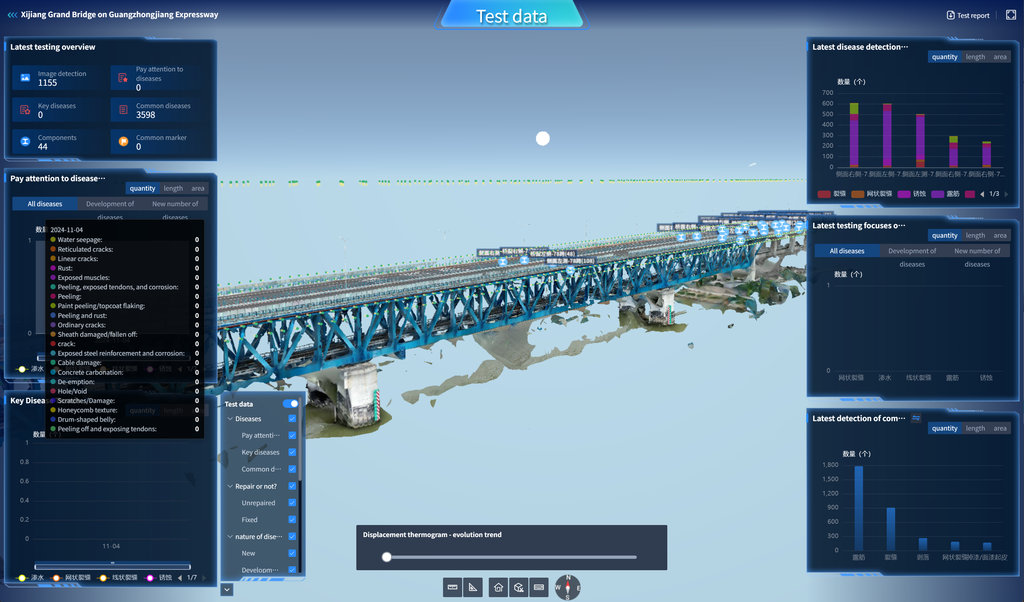
Highlight 3: Full-Process Inspection Management Platform -> Core Features: Supports inspection route planning, real-time data viewing, defect statistics and analysis, automated report generation, and historical data comparison. Connects the full workflow chain of “scheduled dispatch -> automated capture -> data transmission -> defect identification -> data management -> report generation”, enabling digital and intelligent management of inspection work. -> Value Validation: Compared with traditional paper-based report management, report generation efficiency improves by 70% and data query efficiency by 80%, solving the problems of “scattered data, chaotic management, and difficult collaboration” in traditional inspection. -> Field Case: A highway group used this platform to manage over 50 bridges under its jurisdiction, achieving 7×24 inspection readiness. Full-bridge inspection time was shortened from several days to 6 hours, with inspection data synced in real time to the maintenance team, forming a closed-loop “inspection -> diagnosis -> remediation” management process and improving maintenance efficiency by 50%.
Highlight 4: Customized Adaptation Services -> Core Features: Based on bridge type (highway bridge, railway bridge, cross-river bridge) and inspection needs (routine maintenance, emergency investigation, completion acceptance), customized inspection routes and recognition models are developed. Full-process services including on-site deployment, technical training, and equipment debugging are provided. -> Value Validation: Adaptable to over 95% of bridge types. Compared with standardized solutions, customer adaptation satisfaction increases by 25%, solving the “poor adaptability and inability to meet personalized needs” pain points of traditional solutions. -> Field Case: A customized inspection solution was developed for the Aizhai Bridge (China), breaking through three key technologies: high-precision route planning, AI intelligent recognition, and digital twin positioning. 15 standardized routes were planned to cover key components such as the main girder, piers, and cables, increasing inspection coverage from 30% to 70% and earning high recognition from the cooperating unit.
Real-World Scenario Validation: Full Coverage from Emergency Response to Project Delivery
Scenario 1: Emergency Response Inspection -> Case Details: Post-storm bridge emergency hazard investigation (flood-season inspection of a municipal bridge) -> Traditional Pain Points: Slow emergency response, manual inability to quickly reach dangerous areas, incomplete hazard investigation, data unable to sync in real time, easily delaying repair timing -> Solution: Using Riebo Technology’s full-process solution, drones are quickly launched to complete full-bridge image capture in just over 10 minutes. AI software identifies hazards in real time, and the inspection management platform syncs data to the emergency team, providing precise guidance for repairs. -> Actual Results: Emergency response time reduced by 80%, full-bridge hazard investigation completed within 1 hour, 3 hazard points precisely located, avoiding bridge safety incidents and earning commendation from local transportation authorities. Cost reduced by 40% compared with traditional emergency inspection models.
Scenario 2: Routine Operation Inspection -> Case Details: Regular maintenance inspection of highway bridges (daily inspection by a highway group) -> Traditional Pain Points: Low manual inspection efficiency, high risk of high-altitude operations, high miss rate, inspection data not retained, maintenance decisions lacking data support -> Solution: Drones + HD cameras capture imagery, AI software automatically identifies defects, and the inspection management platform handles data archiving and analysis, generating maintenance recommendations regularly. -> Actual Results: Per-bridge inspection time reduced from 3 hours to 30 minutes, inspection frequency increased 10-fold, miss rate controlled within 2%, annual inspection cost reduced by approximately 30%, maintenance team efficiency improved 3-fold, achieving a transformation from “experience-based maintenance” to “data-driven maintenance.”
Scenario 3: Project Completion Acceptance -> Case Details: Completion acceptance inspection of a newly built bridge (acceptance of a new cross-river bridge) -> Traditional Pain Points: High acceptance standards, data must be precise and traceable, tedious manual inspection data recording, long report generation cycles affecting acceptance progress -> Solution: Using Riebo Technology’s solution, full-process inspection data is retained, AI generates compliance acceptance reports, supports data export and review, meeting international bridge acceptance standards. -> Actual Results: Acceptance report generation time reduced from 3 days to 1 day, 100% acceptance pass rate, data precision recognized by the supervision unit, labor cost reduced by 50% compared with traditional acceptance models, accelerating project delivery.
Why Customers Choose Riebo Technology’s Drone Bridge Inspection Solution: 4 Reasons
Reason 1: Significant Cost Reduction and Efficiency Gain -> Evidence: On average, clients reduce inspection costs by 30% and improve inspection efficiency by 60%. Daily deployment can be reduced by 3-5 inspectors, saving approximately 30% of inspection costs over a 5-year cycle. Customer repurchase rate exceeds 85%, earning long-term partnerships with transportation authorities and highway operators across multiple provinces.
Reason 2: Comprehensive Service Support -> Evidence: 7×24 technical support with response time <= 2 hours, 3 free technical training sessions per year, on-site deployment and debugging, dedicated technical consultants to address all customer challenges. After-sales satisfaction reaches 98%, earning widespread industry acclaim.
Reason 3: Complete Compliance Qualifications -> Evidence: ISO 9001 Quality Management System certified. The solution fully complies with international bridge maintenance standards (AASHTO, Eurocode), and inspection reports can be directly used for industry acceptance, helping clients avoid compliance risks and adapt to local UAV aviation regulations (FAA / EASA / CAAC).
Reason 4: Strong Adaptability -> Evidence: Adaptable to multiple bridge types including highway bridges, railway bridges, municipal bridges, and cross-river bridges. Meets various inspection needs such as routine maintenance, emergency investigation, and completion acceptance. Has provided customized solutions for 300+ clients, with an adaptation rate of over 95%, covering complex inspection scenarios such as mountainous areas and cross-river bridges.
Experience Riebo Technology’s Drone Bridge Inspection Solution Today
– Free Demo: Apply for a free demo to experience the full-process inspection service on-site and directly feel the solution’s efficiency and precision;
– Custom Quote: One-on-one requirement consultation, customized solutions and quotes based on bridge count and inspection frequency, with no hidden fees;
Contact our sales team to get your exclusive solution and discover a smarter way to inspect bridges.